
AI innovation is radically changing the field of information operations: from the type and believability of disinformation created (which has become hard to distinguish from human created content), to the speed and scale of distribution. Frontier model operators are now regularly reporting on foreign state actors misusing their platforms to create fake content, run information campaigns at scale, and launder content so it appears to come from authentic voices, and there are now even recent reports of state-backed Chinese and Iranian operations using AI agents to automate much of the end-to-end influence-operation workflow. The importance of AI enabled information operations is starting to be recognised by government, with the UK recently announcing the creation of a National Centre for Information Defence to combat the threat.
However, while it is clear that at least some of the actors running information operations are starting to experiment with AI, we know less about the precise scale of uptake. Has AI become adopted throughout the entire information operations ecosystem; or does it remain something that actors are experimenting with but not fully employing?
We decided to take a first look at this using data from pattrn.ai’s information operations monitor, which collects hundreds of thousands of pieces of content from information operations assets operated by Russia, China, and Iran every day. This tool provides a unique overview of the contemporary information operations ecosystem, and we are already using it to benchmark how vulnerable frontier and open-weight models are being co-opted by foreign state actors into information operations (InfoOps Bench).
We took a random sample of paragraphs of text created by assets in this ecosystem over the last month and scored them on the extent to which they are AI generated, using the Pangram API.
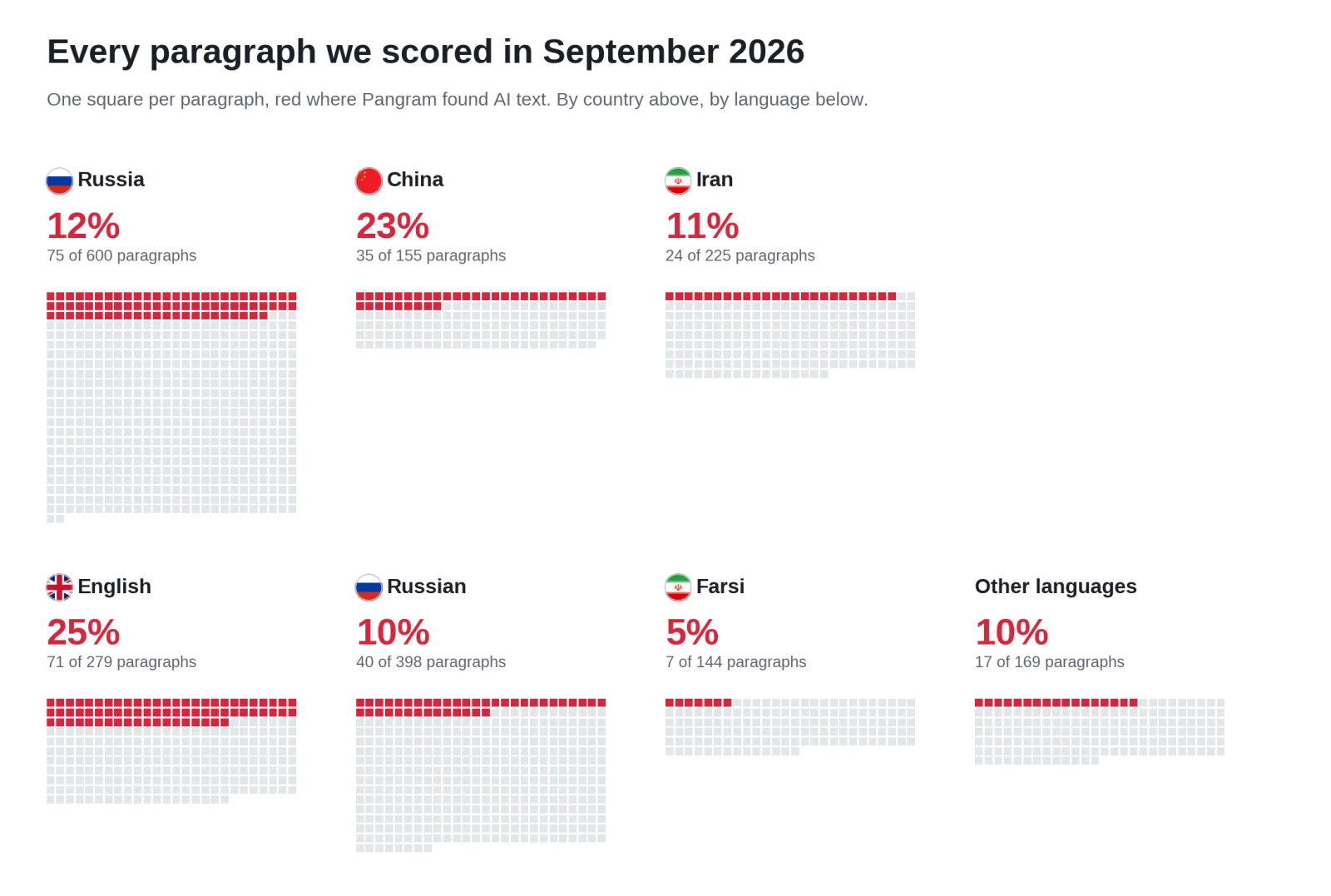
The results show that AI use is starting to come into information operations, though it by no means dominates the landscape. Approximately 12% of paragraphs from Russian information assets we monitor are AI generated, compared to 23% from China and 11% from Iran. In other words, at the moment the majority remain human created. If we break things down by language, we can see a clear tendency towards using AI to create English language content as opposed to content in other languages. This makes sense, and perhaps the biggest immediate uplift generative AI provides to a Russian based disinformation creator is the ability to generate high quality, native level content in a foreign language.
It increasingly appears that AI is being used to write a wide variety of articles and communicate all sorts of different types of disinformation. For example, the Global Fact-Checking Network is a Russian state-linked media organisation – perhaps ironically their code of responsible fact-checking warns that AI can proliferate disinformation. However, one of their own articles on Russia’s attacks on Leipzig airport provides a great example of AI being used to proliferate disinformation, as Pangram scored it as entirely AI-generated.
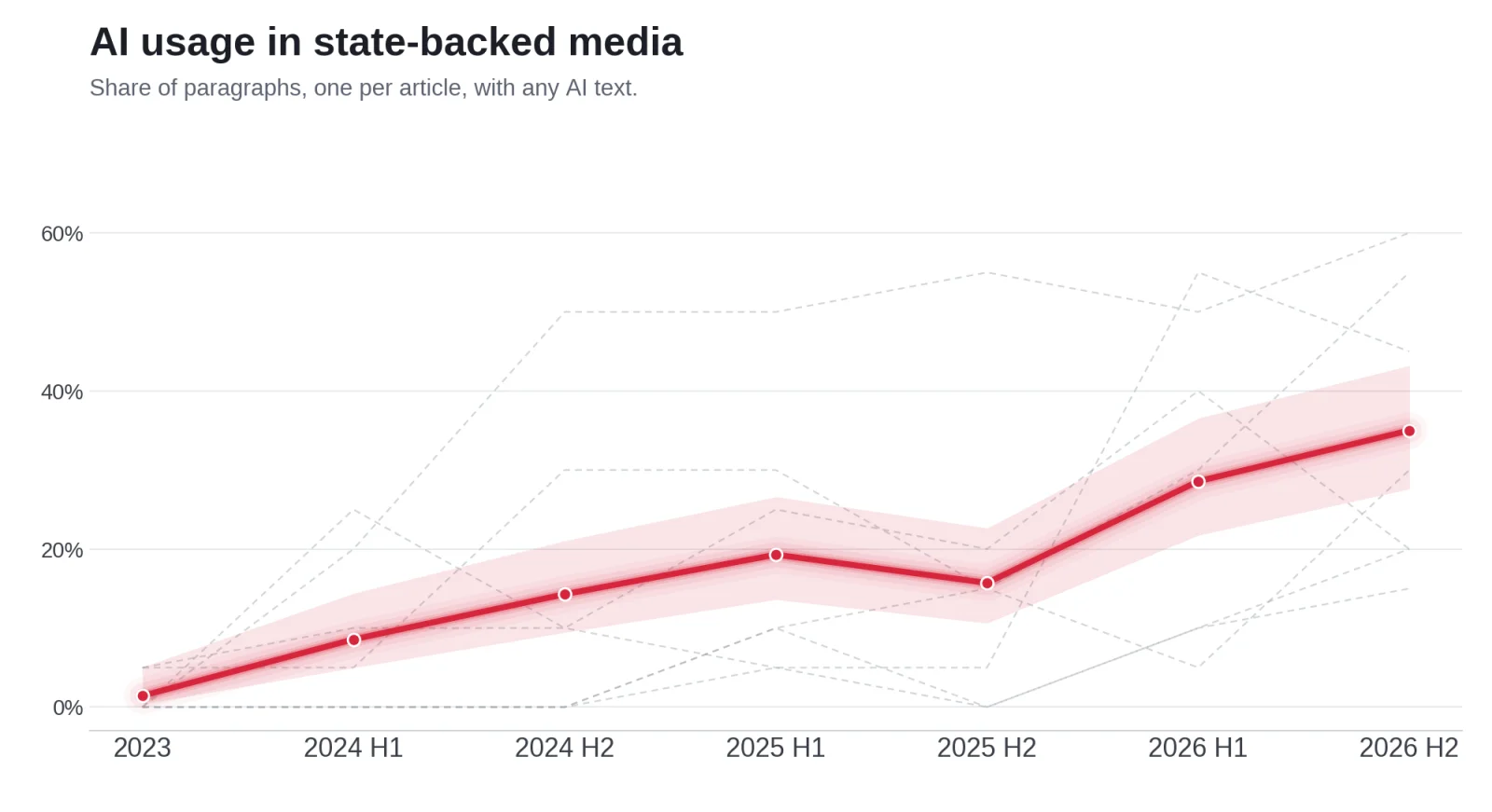
What is also clear is that the trend towards AI use is increasing. Figure 2 shows how AI use has changed in a selection of information operations assets from 2023 to the present. AI use has moved from a very low level to around 35% of measured content in the second half of 2026. Of the 50 outlets we tested, 34 used at least some AI-generated text. Nor is their AI use limited to text, with image generation also increasingly becoming apparent. In our data, the first time we detected an article illustrated with an AI generated image was in May 2023. Our monitor now holds more than 4,000 such images. We intend to investigate the usage of AI-generated images by state media in future work.
It seems very likely that these trends will continue and that we are just at the beginning of AI adoption in information operations. Here at pattrn.ai we will continue to monitor these trends and assess the new risks that AI misuse poses within hostile information operations.
Explore the live data behind this analysis in the Information Operations Monitor.
Open the Monitor